
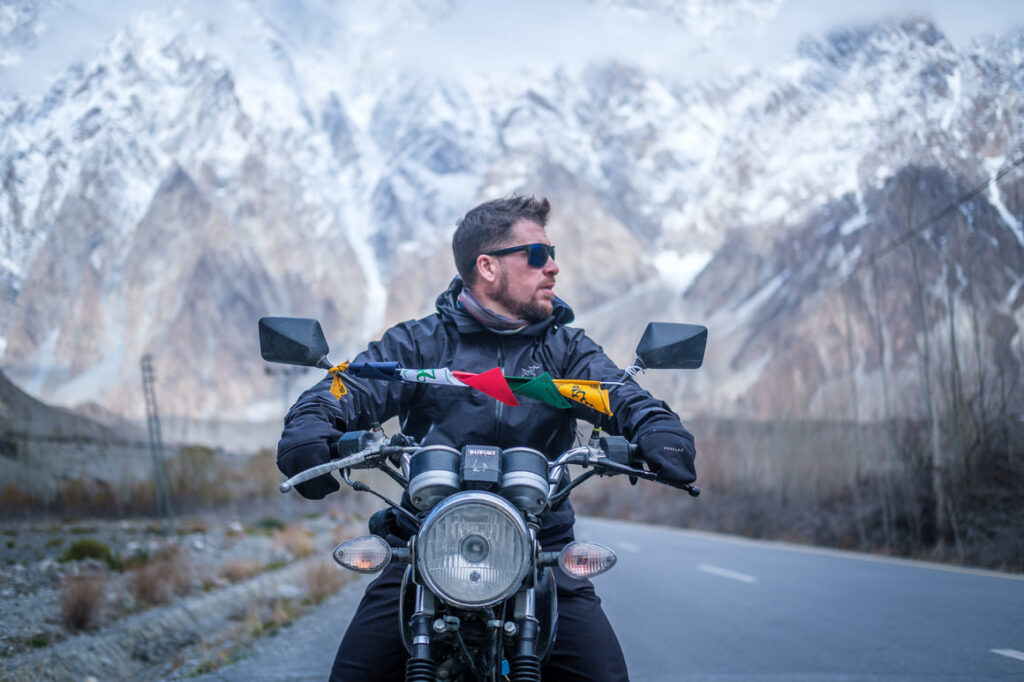
Pakistan Motorbike Pre-Departure Guide
- 18 Days, 17 Nights
- Start Point: Skardu, Gilgit Baltistan, Pakistan
- End Point: Skardu, Gilgit Baltistan, Pakistan
Getting Ready to Experience Pakistan
Ahoy friend!
We’re SO excited you’re coming with us to our favourite country on the planet, a land home to some of the least visited, most magical mountains in the entire world!
Unlike a lot of Pakistan tour operators, we have tried to minimise crazy long drives as our entire trip takes place in the insanely beautiful Gilgit Baltistan territory. Despite an increasing number of people catching on, this region, which is home to 5 of the 14 highest peaks on the planet, still sees minimal foreign tourism and there will be times, hopefully lots of them, where our group has stunning views all to ourselves!
This is the complete opposite of Nepal / India / Bhutan… Gilgit Baltistan is raw, wild mountain magic that you truly cannot find anywhere else in the world. And we’re diving deep – hiking to high-altitude camps, motorbiking on the most surreal road you can imagine, and really getting to know people in their homes whilst staying in homestays owned by people we actually know.
Our route takes us through the stunning Hunza Valley, where we’ll explore by motorbike and visit one of Pakistan’s most remote villages, a spot which Elsewheria founders have been visiting for over a decade. We will also, conditions permitting, explore some remote hidden valleys with thrilling dirt-road biking.
As we journey through one of the final frontiers of adventure travel, you’ll have the opportunity to make lasting connections with fellow bikers and create core memories under the stars as we sit around cheeky bonfires and recount the day’s fresh adventures under star-studded skies.
Pakistan is a very special country to Elsewheria, and we’re excited to share it with you! This is more than just another group trip – but an immersive, intimate mountain adventure that might just change your life! Pakistan is however a truly rugged and raw country and it’s a place where it PAYS TO BE PREPARED – Therefore, please read through this document thoroughly and ensure you do your part to make your own journey as seamless and as comfortable as possible.
Assume you can buy basically NOTHING once you land in Pakistan, bring everything you may need – most importantly of all; a good attitude. We can absolutely guarantee you that something will not go to plan, we may get delayed or stuck due to landslides, plans or even the itinerary may change, weather may not cooperate, and you may come down with a case of mountain-belly, it happens… but, the juice will be worth the squeeze amigos, Pakistan will not disappoint!
Over the coming months, we will be sending you a few forms and documents to return in order to collect the necessary information from you. Please do your best to fill in and return these as soon as you can.
Visa Arrangements - General Information
- As of 2026, Pakistan requires a tourist e-visa to be applied for and paid for by all foreign tourists. While prices differ between nationalities, you can expect to pay around $60 USD.
- E-visas need LOIs (letter of invitation) to ensure they’re processed quickly. We’ll provide this for you, along with a few other documents you’ll need to upload.
- Most visas give you 30 days in the country, which you can extend if you wish to stay longer.
- You will typically be given 90 days to enter the country once your visa is granted, so don’t apply too soon! Six weeks out tends to be the sweet spot. Visas can be granted anywhere from a few hours to a week after you submit.
- It’s important to note that you should choose the country of your passport in the section that asks where you’d like to be interviewed. Ironically, people are only actually interviewed when they choose their embassy as a place they’re traveling to. If you have PR status in a third country you’re applying from and the documents to prove it, you can choose that country/embassy.
- While we can’t apply for your visa for you, we can provide support and guidance. Though the process is a bit more involved than most countries, we’ve never had a guest not get theirs.
How to Get to Pakistan
Pakistan is not the most well-connected country, but you’ve still got several options for international arrival.
We highly recommend you fly into Islamabad International Airport. You will likely have to spend one night here before catching a domestic flight up to Skardu airport – our trip officially kicks off in Skardu, and this is where we will meet you.
Airlines to Look Into:
Thai Airways (direct flights from Bangkok)
- Emirates
- Etihad Airways
- Pakistan International Airlines (direct flights from Kuala Lumpur and Dubai)
- Turkish Airways (if coming from Europe or the US)
- Qatar Airways (again, good options from Europe or the US)
- British Airways (direct flights from London)
Border Crossings:
These are all the border crossings currently available to tourists:
- Khunjerab Border from Tashkurgan, China (open year round)
- Wagah Border from India (closed indefinitely as of May 2025)
- Torkham Border from Afghanistan (chaotic but doable)
- Rimdan Border from Iran (closed as of June 2025)
- Taftan Border from Iran (closed as of June 2025)
Bus Companies:
These are the best companies if you fly into Lahore instead (cheaper, but a lot more hassle) and then need to get a bus to Islamabad:
- Faisal Movers
- Daewoo
- Q Connect (to/from Lahore only)
How to Get to Day 1 (Pre-Tour Arrival Information)
The tour starts in Skardu (this is to save exceptional amounts of time driving), where you’ll be picked up from the airport. Feel free to arrive a few days earlier. Skardu is a solid place to chill.
You will need to arrange a domestic flight that lands in Skardu by 3pm on day 1 of the itinerary. The trip ends when we drop you off in Skardu, so you will need to arrange a return flight from Skardu to Islamabad for the following day.
Islamabad:
While the tour starts in Skardu, your time in Pakistan will begin when you land in Islamabad International Airport. You will most likely need to land at least one day before the start of the tour, as there is only one or two flights a day from Islamabad to Skardu, and they all leave early morning – it’s hard to chain these together with an international arrival into Islamabad. A far cry from the likes of New Delhi, Pakistan’s planned capital is small, abundant in green spaces, and easy to manage. Trust and believe us; you’ll be just fine!
We’ve written a complete guide for Islamabad that includes everything you need to know for your time in the city. Where to stay, where to eat, what to do – and more.
Arriving in Skardu:
Flight schedules typically get released around 6 months in advance. Flights tend to leave early, but not always at the same time, even with one airline. You’ll need to book your flights INTO the country and your domestic flights from ISB to Skardu.
You can typically expect flights to depart to Skardu anywhere from 8 AM to 12 PM.
AirBlue and Pakistan International Airlines are the only two airlines that fly this route. Though you can also take the road, we don’t recommend this on the way there as it will take a very, very long time.
Are Flights Included?
No. International or domestic flights are NOT included. As mentioned, you’ll need to fly into Skardu International Airport (sadly, the name is a misnomer). If you need assistance organising transport or booking your tickets, just let us know and we’ll help you out.
Accommodation in Pakistan
What are the amenities like?
Pakistan and Gilgit Baltistan, especially, are still developing, so don’t expect Western infrastructure or even what you’d find in Southeast Asia or South America here. Still, we’ll stay in a nice mix of guesthouses, an incredible hotel in Karimabad, homestays, and a total of four nights in a tent (2 nights at a time). While it’s not a luxurious adventure, the Elsewheria team has selected high-quality and 100% Indigenous-owned accommodation that members of our team have first-hand experience with.
Wifi exists in Skardu and Hunza, but you’ll need a SCOM physical SIM (which you can get in Skardu) to access data in GB as eSIMs do not work here. Some places we stay will have Western-style toilets and hot water showers, but others do not have running water. Electricity is a problem for locals and may not always be available. It’s all part of the adventure.
The rooms will be twin shares. We’ll pair you with another solo traveller of the same sex, with each of you having your own bed. However, there are double beds available for couples upon request.
If you’d prefer your own private room (for one person) on the trip (except 1-2 homestays), you can select this option. If you’ve already booked and would like to upgrade your package, please get in touch.
This is a real adventure in one of the last wild places on the planet. In exchange for incredible views and cultures, you’ll have to accept that the following Western comforts won’t be possible everywhere, but it really is all part of the experience:
- Wifi
- Phone signal (we have a satellite device for safety)
- 24/7 electricity (many places have backups, but not all)
- Hot showers
- Western toilets
- Bed frames (while camping and in homestays)
Where You'll Stay:
Your nights on this trip are as varied as the landscape: comfortable hotels, cosy guesthouses, a proper canvas-tent camp under the stars (with our AMAZING REI camping gear), and a full week settled into a real Hunza homestay. It’s a mix that’s deliberate: enough comfort to recover properly, enough homestay and camping to actually feel like Pakistan.
Food in Pakistan
Pakistani food is a delicious blend of spices and flavours, with a heavy emphasis on meat (vegetarians/vegans, there are options!). Hunza and other parts of Gilgit Baltistan have their own traditional dishes that are totally different from typical Pakistani food (which has a lot of crossover with Indian) and we’ll be trying it in various settings!
Expect variations of both regional and national favorites, which include everything from your favourite curries, rice dishes, and lentils to freshly made dumplings and spinach pastas on the mountain-cuisine side of things.
Meals are typically served on large, family-style dishes, and are typically eaten on the floor in local homes! Restaurants and hotels do have tables, though.
Here are some of our faves to look out for:
- Hoilo garma: A spinach pasta from Hunza that’s typically eaten for supper and tastes incredible when topped with crushed apricot seeds
- Yak burgers: If you’re a meat eater, we can assure you this is the BEST burger in not just Pakistan but maybe all of Asia!
- Karahi – A perfectly spiced chicken dish bathed in a delicious tomato sauce. Mixing in plain yogurt really hits!
Staying Safe on this Tour
Our adventure takes us through some of the safest places in Pakistan that have virtually no crime at all. Pakistan is safe for foreign tourists in general, and for sure, one of the most hospitable countries on Earth, but traveling as a group is extra secure.
We’ll also have a guide from Gilgit Baltistan with us who speaks multiple local languages to sort anything out. Islamabad is also an easy-to-handle arrival city pre-Skardu, with less crime than many European metros.
Even so, biking and hiking through some of the highest mountains in the world carries its own set of risks, and we strongly recommend coming prepared with the right gear and the right riding experience.
Guest Safety is Elsewheria’s #1 priority, and our experienced ground team does everything within their power to set our group up for a safe adventure. The name of the game is security and safety first, and injury prevention. We take it very seriously.
Travel Insurance for Pakistan
You cannot join this Elsewheria adventure unless you buy travel insurance.
You will need to prove you have insurance by providing a photocopy of your policy. You also need to sign a waiver (mentioned previously), releasing the guides, Elsewheria, and our partners in Pakistan of any liability.
The travel insurance company that we recommend is Rise and Shine. These guys are experts in adventure travel, which is why they are our go-to.
Medical Considerations Before Travelling to Pakistan
Before heading to any overseas country, you should always check out your government’s health advice. Below, you can find links to various government websites that outline this for travel to Pakistan:
UK: https://www.gov.uk/foreign-travel-advice/pakistan/health
USA:https://wwwnc.cdc.gov/travel/destinations/traveler/none/pakistan?s_cid=ncezid-dgmq-travel-single-001
Canada: https://travel.gc.ca/destinations/pakistan#health
Australia: https://www.smartraveller.gov.au/destinations/asia/pakistan
Most importantly, consult with a quality health care professional or travel doctors before departure to be sure you’ve got all the correct vaccinations, etc.
Religion/Culture
Cultural Etiquette Tips
Pakistan is a very conservative Islamic country as a whole, though the regions we’ll be visiting are definitely the most liberal places out there that are used to foreign tourism. Even so, you’ll still find lots of differences from the Western world.
Hunza is the only place you’ll see women owning businesses, though this is still a small number. In the rest of our itinerary stops, you’ll find that this is truly a man’s world. While we’ll meet and support various women-led initiatives, men and boys are who you’ll primarily see out on the street.
The majority of marriages are arranged (though this is modernizing among the younger generation, particularly in Hunza), and most women are stay-at-home moms. People generally dress conservatively in the local shalwar khameez, though you may see younger guys wearing Western clothes.
Unlike Afghanistan or Iran, the hijab is NOT mandatory for women unless you’re entering a mosque or shrine, neither of which is on our itinerary.
Overall, cities are much more conservative and surprised by foreigners than anywhere in Gilgit-Baltistan. People throughout the territory may vary in what sect they follow, but overall, you’ll find more tolerant and unbothered attitudes than anywhere in the mainland.
There are many sects of Islam, and while the majority of Pakistanis are Sunni at more than 80%, we’ll primarily encounter Ismailis and Shi’as on our trip. While individuals may differ, Ismailis are significantly more liberal, tolerant, and open-minded than any other sect.
- Skardu: Quite conservative as nearly all locals follow Shi’a Islam, though people are warm, friendly, and happy to see foreigners. You can still see and sometimes meet local women here. Many cultural similarities with more liberal parts of GB
- Hunza Valley: Undoubtedly the most liberal and open-minded place in the entirety of Pakistan, the majority of locals (including our guide and driver) are Ismaili Muslims, a small minority sect that highly values education and women’s rights. Hunza is the only place where you’ll see regular owning businesses.
- Nagar Valley: Local culture and ethnicity is very similar to Hunza, but like Skardu, locals are almost exclusively Shi’a instead of Ismaili. Still, people are warm and welcoming and are still happy to see tourists, and women can be seen outside the home, though you will see them dressing more conservatively than folks in Hunza.
A few things to think about for the trip:
- Avoid talking about religion or politics generally.
- Never wear shorts as a woman
- For women: don’t shake hands with men, and instead put your hand over your heart
- For men: don’t shake hands with women
- Don’t be too friendly with the opposite sex
- Note that people are proud of their food and appreciate it if you try even a bit
- Don’t wear anything with an American or Israeli flag on it.
Language
ALL schools in Pakistan are taught in English, and the vast majority of the population speaks some of it. We find that language is really not an issue here, as there will always be someone around who is a fluent English speaker, even in very remote villages.
It’s even one of the “official” languages: you’ll see many signs and government notifications are written in English, though most people likely learned Urdu first, the other official language. Urdu is almost exactly the same as Hindi, apart from the script.
Be aware that Pakistan and Gilgit-Baltistan are both extremely linguistically diverse, with more than 70 unique tongues being spoken throughout the country as a whole. On our trip, we’ll encounter Urdu, Burushaski, Wakhi, Shina, and even some Balti whilst in Skardu.
Money in Pakistan
The country uses the Pakistani Rupee (PKR) and the country is still a VERY cash-based society. Outside of Islamabad (or other major cities), expect to pay in cash for everything. In Gilgit Baltistan, you may find a few restaurants or hotels with card readers but they don’t always work.
Some people have issues with ATMs while others do not. Yes, many banks do not work with foreign cards, but a good number (you’ll also find in the mountains) operate just fine.
These are the companies to look for:
- UBL
- Bank Al Falah (best option for Mastercards)
- Allied Bank
- HBL
- Standard Charter (only in Islamabad/other major cities)
We strongly recommend changing money in Islamabad, where there are various shops in a neighbourhood known as Blue Area. We’ve personally used Riaz Money Exchange. Note that there is one exchange in Gilgit, but that’s it. If you’d like to tip guides, they can accept foreign currency
How much should you bring?
To cover additional meal costs, souvenirs, tipping, and whatever else you end up buying, we recommend bringing $400-$500 USD. This can always be exchanged back.
It is always better to have MORE than you think you need, just in case.
Tipping Staff and Porters
The Elsewheria team goes above and beyond for guests before, during, and after the trip to make sure that everyone has the best possible mountain experience imaginable.
So, how do you show your guides some love? Well, besides bringing good vibes, good hiking snacks, and laughing at their jokes, tipping is appreciated.
Below we have included the industry standard recommendation to offer our staff some additional compensation based on your overall experience and keeping in mind the length of the trip and how hard we work to ensure you have an incredible time in Pakistan.
A generous tipping budget to cover all your bases is around $300-$500 USD for the entire trip, and you’ll have the cash anyway if you don’t end up needing it.
Tipping recommendations:
- Tips for your western guide can be paid in USD/EURO cash post-trip or via Venmo, Wise, PayPal, etc.
- Pakistani local guides can accept PKR, USD, or Euros
SIM Cards and Internet Access in Pakistan
Pakistan has several different mobile networks, and they all work best in different places, which can make things confusing. You’ll have access to Wifi in Islamabad, Skardu, and Central Hunza but don’t count on it once we reach the mountains.
SIMs in major cities like Islamabad can be difficult to get, which is why I highly recommend the following plan to stay connected throughout our adventure:
- Get an eSIM before you arrive to use in Islamabad. It’s important to note this will NOT work in most or all of Gilgit Baltistan
- Once we all convene in Skardu, we’ll take a trip to the local SCOM (provider that only functions in Gilgit Baltistan) shop, where it costs around $10-$12 USD to get a local, physical SIM with 25 GB, as eSIMs are not yet a thing up here. This is typically a very quick process, unlike mainland providers.
- If your phone does not have a SIM card slot, we advise bringing a backup or buying a cheap phone in Pakistan to act as a hotspot if you want to stay connected
- Keep in mind that there will be places without service or with very minimal such as: Parts of Fairy Meadows, Shimshal Valley, and Rakaposhi Basecamp. In Gilgit Baltistan, the internet does get cut out on occasion due to weather or political issues, though this is not the norm. We will be equipped with a Garmin inReach satellite device throughout the trip, just in case.
Weather Conditions in Pakistan
Both May and October are ideal times to be exploring the mountains of Gilgit Baltistan – both are shoulder seasons where the summer heat waves (yes, sadly this is a thing!) are skipped and domestic tourism is minimal. While it could rain, recent years have been sunny with comfy, summer-like days and cool but comfortable nights.
Daytime temps can still get to a real feel of around 77 F (25 C) in lower altitude areas, and about 10-12 degrees colder at places like Patundas where we’ll be at a higher elevation (4300m).
Nights are definitely chillier, and although a solid jacket will still come in handy, you can expect temperatures to be between 55-65°F (10-18°C), depending on our location. Our nights camping will naturally be where you want to be the most prepared.
Keep in mind that typical weather apps are unfortunately VERY inaccurate when it comes to Gilgit Baltistan’s temperatures. Many weather stations are placed on glaciers, which often makes it seem like it’s much colder here than it really is. The entire territory has a four-season climate with cold, somewhat snowy winters and hot summers, so very similar to the Northeast United States.
What to Pack for Pakistan
Your Pakistan packing list is essential to get right for a comfortable trip in the Karakoram. While you can find many international brands in Islamabad and other cities, these do not exist in Gilgit-Baltistan, especially when it comes to gear. You can find some great items second-hand, but the selection will vary. There are a few mountaineering shops, but they don’t tend to have too much original, brand-name gear.
All the more reason to get kitted up in advance, you’ll be happy you did!
We’ve made a full-on Pakistan packing list to get you ready for our mountain odyssey – PLEASE READ THIS!!!
Laundry
Although you might get the opportunity to do laundry along the way through the homestays/ hotels, it is not guaranteed. We are not staying long in each place, so there may not be enough time for the hosts to do it.
Please pack assuming you will not have laundry available. Unless you call washing your underwear in the bucket, which is present everywhere in Pakistan, laundry, then yes, you can do it!)
Camping Equipment
We have fantastic MSR tents which we use on our expeditions – these are 3 person tents which we put two people in, so are relatively spacious. We have invested in some excellent quality sleeping bags, thermarests and hiking poles. This gear cost us over $15,000, and we’re very proud of it. This gear is available to rent as follows, but we need to know IN ADVANCE if you want it or not.
In our opinion, it’s worth having sleeping bags for both of the camping sections (4 nights total)
Hiking poles are well worth having.
If you already have your own gear, feel free to bring it along! If you want to hire from us, rates are below –
- Sleeping bag: $10/day
- Inflatable sleeping mattress: $5/day
- Trekking poles: $5/day
Recommended Reading on Pakistan
The history of Pakistan is intense, and many think that Gilgit-Baltistan’s history is completely intertwined. In reality, GB is a territory (not an official province/state) and home to unique ethnic groups and cultures that are very different from the Mainland.
Hunza Valley for example, used to be a princely state and was not included as a part of Pakistan until 1973. It’s definitely not something we’re typically taught about, so I encourage you to read a bit up on the region (and a few on Pakistan generally) with these reads:
Post Trip Tips
Leaving Skardu
Flight schedules typically get released around 6 months in advance. Flights tend to leave early, but not always at the same time, even with one airline.
You can typically expect flights to depart from the Skardu Airport anywhere from 8 AM to 12 PM. AirBlue and Pakistan International Airlines are the two airlines.
Again, here are our recommendations of where to stay in the capital:
- Coyote Den Hostel (Budget)
- Jasmine Inn (Mid-range, central location)
- Islamabad Serena Hotel (Luxury)
Some other things to know:
- If you want to do any money exchanges, we have personal experience with Riaz Money Exchange in the Blue Area neighbourhood
- If you bought a SCOM SIM card in GB, it will still work in Islamabad if you switch the network to Ufone
- To get from the airport to your accommodation, use inDrive, take a taxi, or arrange a pickup with your hotel
- If you want to spend more time in the country, we highly recommend spending more time in Gilgit-Baltistan or Chitral. It will be unbelievably hot (35 °C+) in any of the historical cities, which are best visited from November to late February.
International Departure
While many have booked their flight out of the country, do keep in mind that it may be very tight if any flight from the mountains gets cancelled. So definitely don’t have an international departure booked for 3 AM on the day following your domestic flight at least… If you ARE going to cut it close then WE STRONGLY RECOMMEND that you book your flights with change options so you can change your flight to the next day if your domestic flight is cancelled, meaning you will be delayed.
If you have the time, I’d recommend banking this as a buffer day to just relax in some nice AC in ISB and plan to fly out the day after.
Meet Your Guides
We have a team of incredible guides who lead our expeditions. We will let you know who your specific guide is closer to the time. But to get to know your potential hosts, you can check out our Meet the Team page.
Terms and Conditions
Please find our full terms and conditions here.
Any Questions
Please check out our FAQs on the tour itinerary page, or email me at will@elsewheria.com
Again, we are very excited to get to meet you in person in Pakistan soon!